Hourly visiting care at home.
A carer attends at set times for washing, meals, medication or company, and leaves the rest of the day to your relative. It is the least intrusive first step.
£36.95/hour · Explore hourly care →


Alternative to a care home
Care home alternatives are worth examining fully before any decision is taken. From an hour a week to full live-in support, there is a level of care at home for almost every situation, across Surrey and the rest of Surrey.
“Aims Homecare are absolutely fantastic, we do not know what we would do without them.” — Mr F. Eerin, verified review, homecare.co.uk
The starting point
When a parent begins to struggle, many families assume that a care home is the inevitable next step. It is one option among several. Around 97% of people say they would rather stay in their own home than move into a care facility, and with the right support most are able to. A good care home suits some families very well. Where it does not, the care home alternatives set out below allow a person to keep their home, their routines and their community, with professional care arranged around them.
Compare
at £245 per 24 hours (£1,715 per week)
typically £1,400 to £1,800+ per week, per person
Our full guide to care homes vs home care sets out the detail behind these figures.
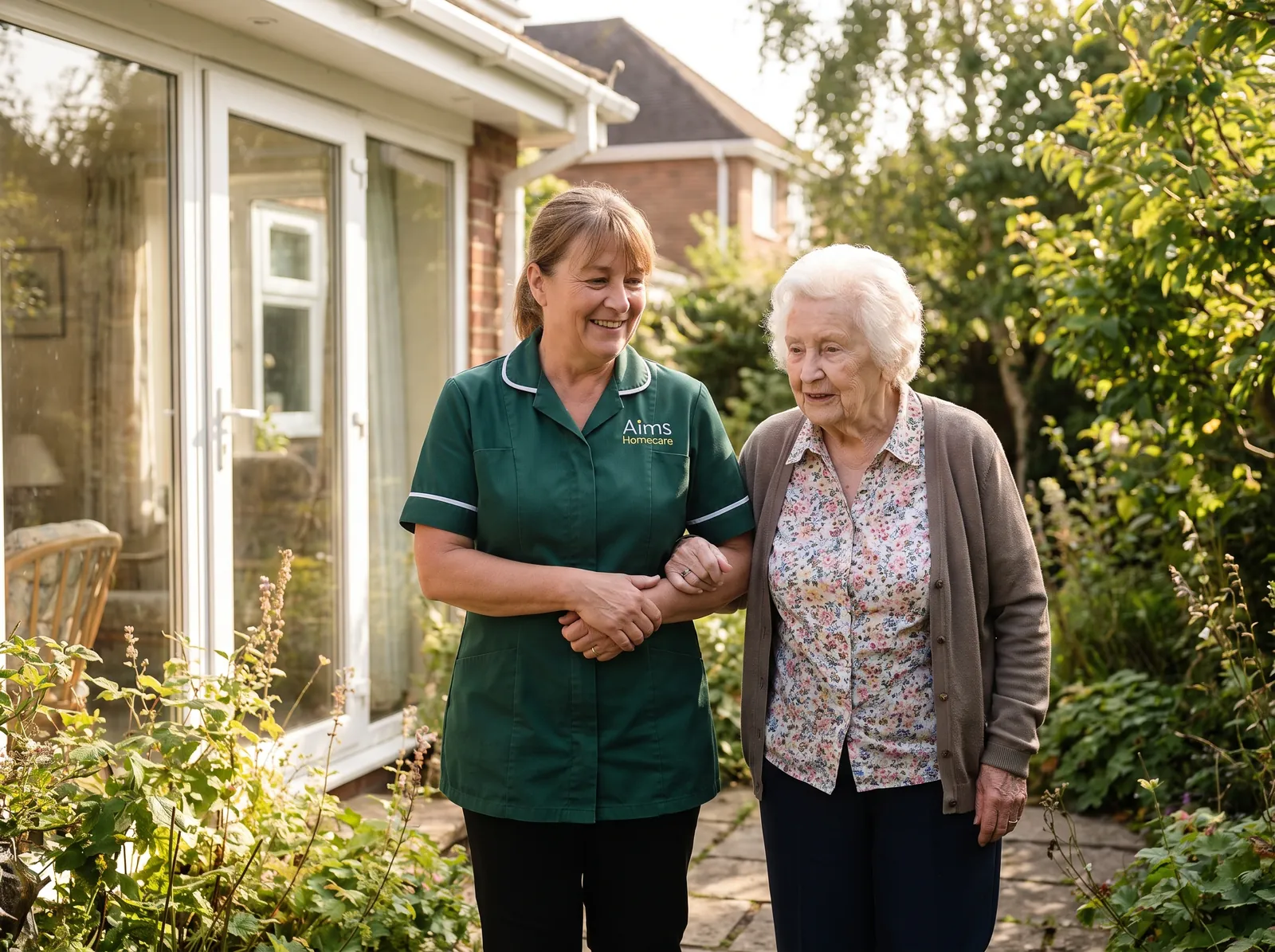
What staying home protects
A home represents decades of memory and identity rather than simply an address: the chair by the window, the roses at the back, the neighbour who waves each morning. Care at home keeps all of it in place.
The ladder of alternatives
Most families need less care than they anticipate. Care at home is incremental rather than a single decision: it begins with a few visits a week, and further support is added only when it is genuinely required.
A carer attends at set times for washing, meals, medication or company, and leaves the rest of the day to your relative. It is the least intrusive first step.
£36.95/hour · Explore hourly care →
Where the days are manageable but the nights present risk, whether from falls or night-time confusion, a carer stays overnight, sleeping or waking, so that the household rests.
£175/night · Explore night care →
A trained carer lives in the home and provides one-to-one support around the clock. It is the closest equivalent to a care home, provided without anyone moving.
£245/24 hours (£1,715/week) · Explore live-in care →
Cover for a family carer's holiday, or a bridge home after a hospital stay. Full support from a few days to several months, with no long-term commitment.
From £29.95/visit or £245/24h live-in · Explore respite care →
Why home matters
Three effects are consistently reported by families who choose care at home rather than a move.
Live-in care is associated with fewer falls than residential settings. A familiar layout, one-to-one attention, and routines that do not change with a shift rota all contribute to steadier mobility.
Familiar surroundings are especially valuable for a person living with dementia. The same kitchen, the same view from the window and the same chair act as anchors that a new environment cannot immediately provide.
Making a cup of tea, feeding the cat or tending the roses are small acts of independence that protect confidence and purpose. Care at home is designed to preserve them rather than replace them.
Choosing well
Where a care home does prove to be the right answer, it is worth choosing carefully. The six questions below are useful to put to every home you visit.
Headline fees often exclude hairdressing, escorted appointments, outings and higher-dependency charges. Ask for a worked example.
Familiar faces matter enormously, so ask about staff turnover and agency use, not just the staff-to-resident ratio.
Some homes register residents with a linked practice. Losing a GP who has known someone for twenty years matters more than it first appears.
Most homes are unable to accommodate pets. Where a cat or dog is important, establish the position before any decision is taken.
Ask whether a shared room is guaranteed, and what happens if one partner's needs change and a move within the home becomes necessary.
Check the notice period, the position on fee refunds, and what happens to any room deposit. The exit terms are worth understanding before signing.
Care at home
Full live-in care at £245 per 24 hours (£1,715/week), compared with £1,400 to £1,800+/week per person in a care home. No call-out fees, no hidden charges. Every price is a starting "from" rate, and your exact quote is confirmed after a free physical assessment at your home. Same rates 7 days a week, with no weekend premium; Bank Holidays are charged at double the standard rate.
Hard-won wisdom
After fifteen years and more than 2,000 customers, the same four points recur in conversations with families who have already made the decision.
Nobody needs to move directly to round-the-clock care. Two visits a week can become daily visits, then night cover, then live-in support, with each step taken only when it is genuinely required. Families who begin at the lightest level retain the most control over the decision.
Most families assume that one-to-one care at home must be considerably more expensive. The costs are in fact comparable: live-in care starts at £245 per 24 hours (£1,715/week) against typical care home fees of £1,400 to £1,800+/week per person, and for a couple one carer on one bill replaces two sets of fees.
Leaving home is a significant upheaval, and a period of disorientation after a move is common, particularly for someone living with dementia, for whom familiar surroundings act as an anchor. Where memory is part of the picture, our page on dementia care at home is worth reading first.
Home care can be increased, reduced or stopped, and a care home trial can be ended. Once the house is sold, however, the option of returning home no longer exists. Our advice is to consider every option at home before that decision is taken, because it is the only one that cannot be reversed.
How it works
The process below applies whether or not you decide to use our service.
We visit you at home, or in hospital, and set out every option, including those we do not provide ourselves.
A clear plan at the appropriate level of support, with a written quote and no pressure to proceed.
You meet your DBS-checked, trained carer before care begins, because the right match matters as much as the right service.
We increase or reduce support as needs change, and keep the family informed at every review.
Care can begin within 24 to 48 hours of your assessment.
"Aims Homecare are absolutely fantastic, we do not know what we would do without them."
"Excellent service. The carers we have are brilliant and so kind and caring. Always so attentive."
Questions families ask
Yes, with the right level of support. Safety is built into the care plan through medication prompts, mobility support, meal checks and health and wellbeing checks at every visit. Where risks increase, we can add night care or move to live-in support, so that someone is always present.
Support is increased without any move being necessary. Many of our customers began with two visits a week and added daily visits, then night cover, then live-in care. Regular reviews mean the care plan changes in step with your relative.
Yes, the costs are comparable. Live-in care starts at £245 per 24 hours (£1,715/week), while care homes typically charge £1,400 to £1,800+/week per person. For couples the case is even stronger: one live-in carer supports both partners on one bill, quoted at your free assessment, whereas a care home charges per person, per room. See our pricing page for details and funding options.
Yes, and we would encourage it. There is no long-term contract, so you can begin with a few hourly visits, or try short-term live-in care for a week or two, before any larger decision is made. Trialling care at home costs considerably less than reversing a move.
Begin the conversation early and lead with what your parent keeps: the home, the garden, the pet, the neighbours, rather than with what is changing. Presenting care at home as support for independence, rather than a loss of it, alters the tone of the discussion considerably. Our guide to the signs it may be time for live-in care is a useful starting point.
It depends on the stage of the condition. In the earlier stages, visiting dementia care, with medication prompts, meal checks and a consistent familiar carer, is usually safe and genuinely protective, because familiar surroundings support memory. As risks increase, with wandering, night-time confusion or unattended appliances, living alone ceases to be safe and the choice becomes night care, live-in care or residential care. Live-in care retains the familiar home, which is what most benefits a person with dementia. We will always tell you plainly which stage we believe has been reached.
Yes, and the most effective care plans usually combine several sources. A daughter covers weekends, a day centre provides a social anchor midweek, and our carers cover the remaining gaps: mornings, medication or nights. We build visits around what family and community already provide rather than duplicating it, so that you pay only for the hours you need, at £36.95/hour.
Support is increased, with more visits, night cover, or a move to full live-in care, usually within days, because regular reviews identify the change in advance. Where we believe a residential care home is the right answer for your relative, we will say so and help you plan the move properly. Our responsibility is the right care, not necessarily our care.
Related services
Alternatives near you
Aims Homecare helps families across Surrey explore genuine alternatives to care homes. If you've been searching for ways to avoid a care home in Surrey, stay-at-home care, or home care instead of a care home, our local team on Surrey Road, Surrey can take you through every level of support, with no obligation.
The alternatives range from hourly visiting care at £36.95/hour and overnight care at £175/night, through respite care at the same visiting and live-in rates (from £29.95 per visit or £245 per 24h live-in), up to full live-in care at £245 per 24 hours (£1,715/week), one-to-one, round-the-clock support in your loved one's own home, comparable with £1,400 to £1,800+ per week per person in a typical care home. For a husband and wife, live-in care for couples, with one carer and one bill quoted at your free assessment, keeps both partners together under one roof.
Every option begins the same way: a free care assessment at home or in hospital, a written care plan, and a clear quote from a CQC-regulated provider rated Good. Our guide to care homes vs home care and our pricing and funding options cover the comparison in full, or call 01372 386222, and care at home can begin within 24 to 48 hours.