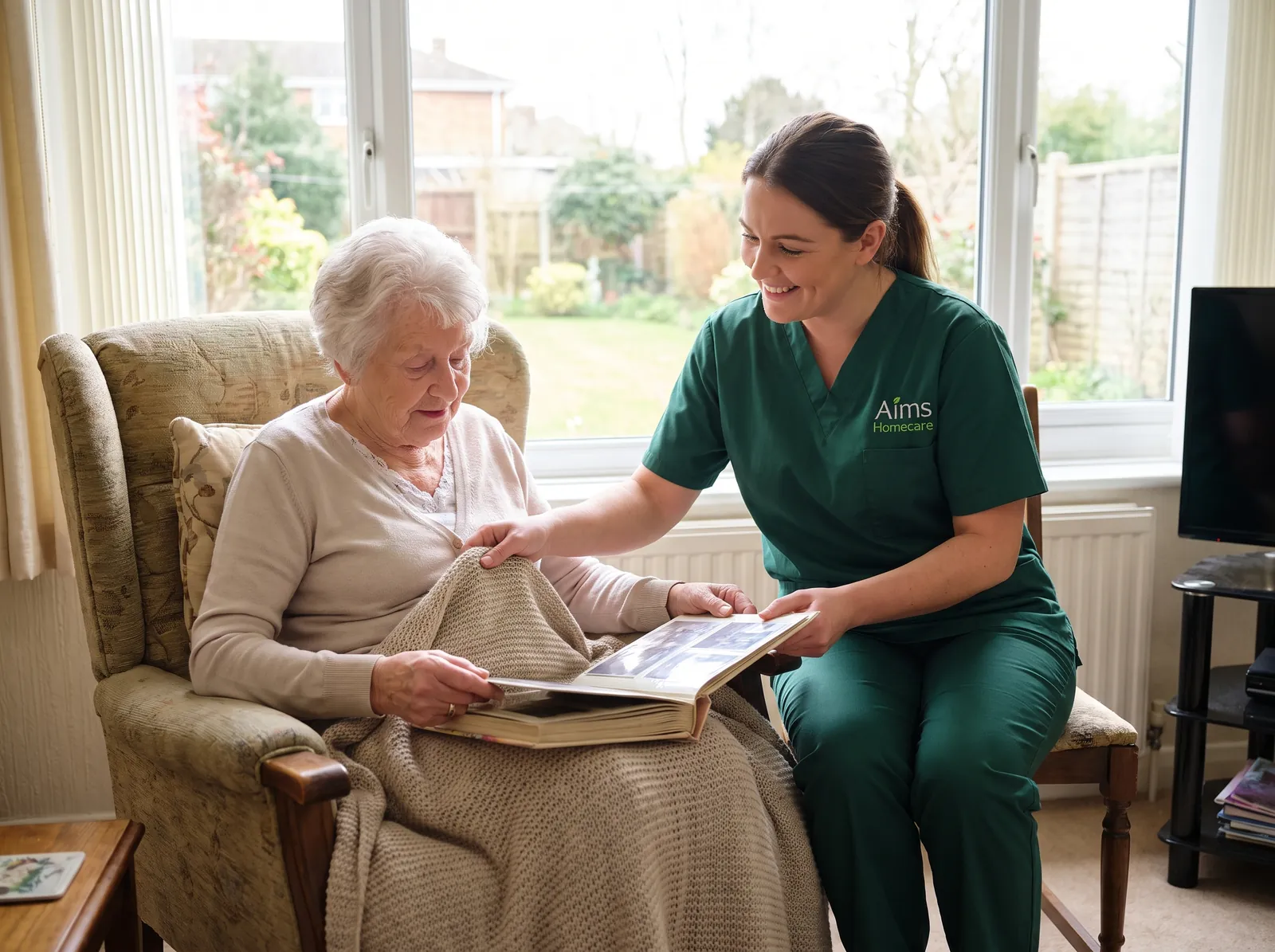
An Aims carer sharing a warm moment with an elderly lady living with dementia in her own home
Dementia-trained carersSpecialist support
Home/Services/Dementia care

Dementia care

Dementia care at home,
built around the person.

Specialist dementia care at home across Surrey, with the same familiar carers, the same familiar rooms, and a routine built around who your loved one has always been.

CQC rated  Good Dementia-trained  carers From  £36.95/hour Familiar surroundings ·  Protect memory

“Dad has two fantastic carers who are very understanding to his needs and moods.” — Frances E, verified review, homecare.co.uk

Understanding dementia care

Dementia care at home in Surrey.

Dementia care at home means trained carers supporting your relative in their own house, keeping routines steady, memories anchored and dignity intact, from short daily visits through to full live-in care. The need is considerable: around 982,000 people are living with dementia in the UK (Alzheimer's Society, 2024), and around one in three people born today will develop it in their lifetime (Alzheimer's Society). Most people would prefer to remain in their own home and that is what our dementia care at home makes possible for families across Surrey and the towns around them.

The types of dementia

The main types of dementia explained.

Dementia is an umbrella term for several different diseases of the brain. Each affects daily life differently, so our carers adapt their support to the type of dementia, not simply to the diagnosis.

Alzheimer's disease and memory loss.

The most common cause of dementia, accounting for around 60% of diagnoses in the UK (Dementia UK). A build-up of proteins damages brain cells, and memory for recent events usually fades first. Day to day, that means repeated questions, misplaced belongings and growing muddle over dates and appointments, while older memories often stay vivid. How our care adapts: consistent carers, steady routines and reminiscence work that reaches the long-held memories Alzheimer's touches last.

Vascular dementia after reduced blood flow.

The second most common type, accounting for around one in five dementia cases in the UK (Alzheimer's Research UK). It is caused by reduced blood flow to the brain, often after a stroke or a series of mini-strokes, so change tends to arrive in steps rather than gradually. Thinking speed, planning and concentration are usually affected before memory. How our care adapts: unhurried support with sequencing everyday tasks, close attention to blood-pressure and medication routines, and quick escalation if we notice a sudden change.

Dementia with Lewy bodies.

Accounting for 10 to 15% of dementia diagnoses (Dementia UK), this type causes alertness that fluctuates from hour to hour, visual hallucinations that can feel completely real, sleep disturbance and movement problems similar to Parkinson's. How our care adapts: carers who never argue with a hallucination but calmly reassure, extra vigilance around falls, and flexible visits that work with good hours and bad ones rather than a rigid clock.

Frontotemporal dementia and personality change.

A rarer form, affecting around one in 20 people with a dementia diagnosis (Dementia UK), and an important cause of dementia in younger people (NHS). It affects the front of the brain first, so personality, behaviour and language often change before memory does, which families can find especially hard. How our care adapts: carers briefed on which changes come from the disease and which belong to the person, structured days that reduce impulsive risks, and patient support with communication as words become harder to find.

Mixed dementia and overlapping symptoms.

Many people have more than one type at once, most often Alzheimer's disease alongside vascular dementia. At least 1 in 10 people diagnosed with dementia have mixed dementia (Alzheimer's Society). Symptoms blend, so no two days and no two people present in quite the same way. How our care adapts: a care plan built around the symptoms actually in front of us rather than a textbook label, reviewed regularly as the picture shifts.

Young-onset dementia before age 65.

When symptoms begin before the age of 65, as they do for more than 70,800 people in the UK (Alzheimer's Society). Younger people are often still working, driving or raising families when dementia arrives, so the practical and emotional disruption is different. How our care adapts: support that protects independence, work and family life for as long as possible, with carers matched for energy and interests as well as skills.

What causes dementia in the UK.

Approximate share of dementia diagnoses by type

Alzheimer's disease~60%
Vascular dementia~20%
Dementia with Lewy bodies10 to 15%
Mixed dementia1 in 10+
Frontotemporal dementia~1 in 20

Sources: Alzheimer's disease around 60% of diagnoses (Dementia UK, citing NICE); vascular dementia around one in five cases (Alzheimer's Research UK); dementia with Lewy bodies 10 to 15% of diagnoses and frontotemporal dementia around one in 20 (Dementia UK); mixed dementia at least 1 in 10 (Alzheimer's Society). Categories overlap, because many people have more than one type, so shares total more than 100%.

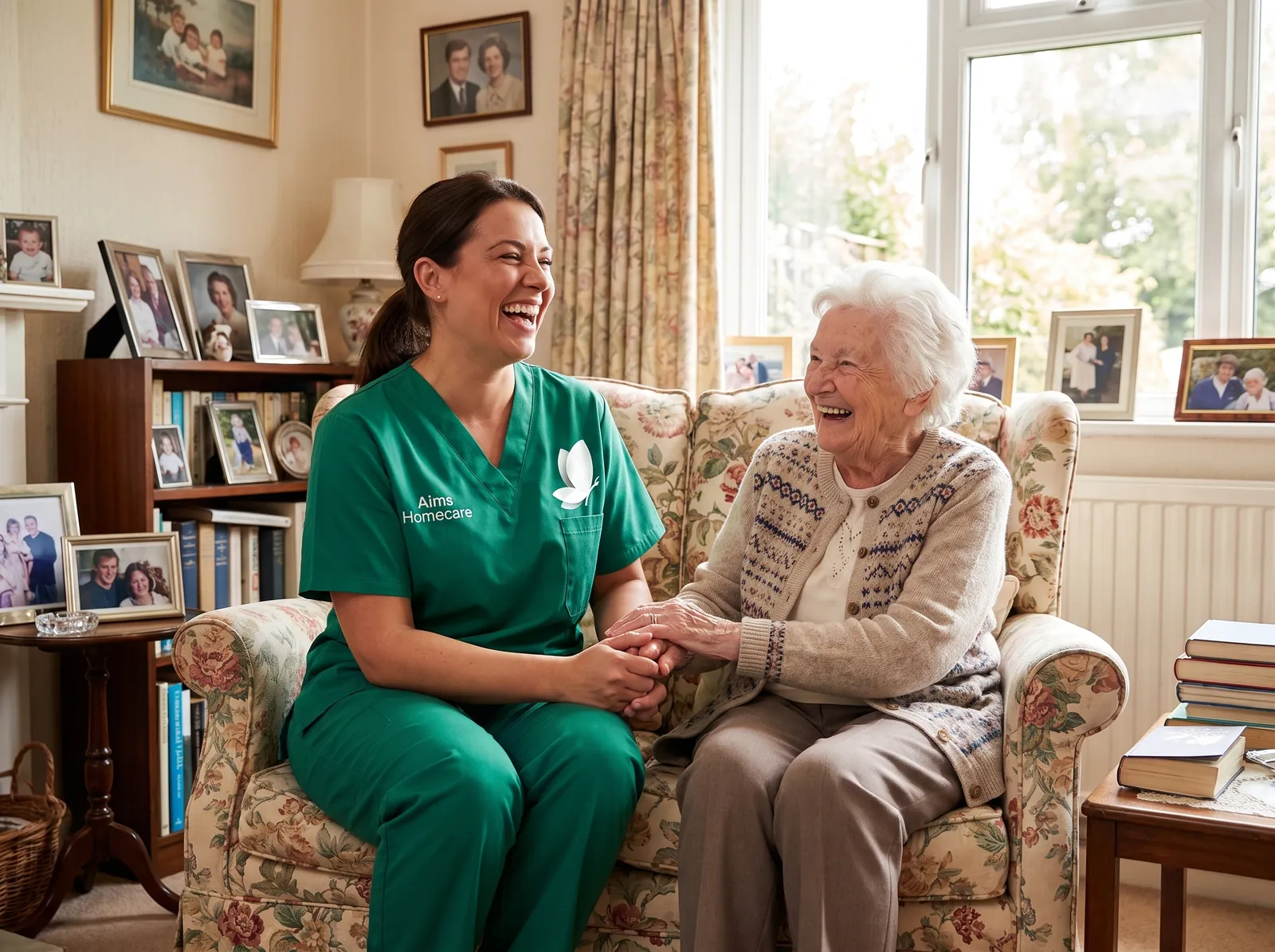
Recognise the early signs

The changes families tend to notice first.

Dementia usually begins with small changes that a family notices long before anyone else does. If several of these are familiar, an appointment with the GP is a sensible next step, and our team is glad to talk things through with you.

Changes in memory and thinking.

  • Repeating the same questions or stories
  • Misplacing items in unusual places
  • Losing track of dates, times or appointments
  • Struggling to follow conversations or plots
  • Getting confused in familiar places

Changes in behaviour and daily life.

  • Familiar tasks such as cooking and bills becoming hard
  • Missed meals, or food left uneaten in the fridge
  • Less attention to washing, dressing or the home
  • Medication doubled up or forgotten
  • Poor judgement with money or strangers

Changes in mood and communication.

  • Withdrawing from hobbies, friends and calls
  • Uncharacteristic anxiety, suspicion or irritability
  • Searching for everyday words mid-sentence
  • Low mood or flatness that does not lift
  • Restlessness late in the afternoon or evening

What's included

What dementia care at home includes.

Every care plan is individual, though dementia care at home rests on the same foundations.

Consistent, familiar carers

The same faces at every visit, because familiarity builds trust.

Structured, gentle routines

Predictable days that reduce anxiety and confusion.

Meaningful activity & reminiscence

Music, photographs and familiar skills reach long-held memories.

Nutrition & hydration prompts

Carers encourage regular meals and drinks without pressure.

Medication support

Carers prompt the right dose at the right time and collect prescriptions.

Personal care with dignity

Carers assist with washing and dressing at your relative's pace.

Safety without restriction

A safer home and attentive supervision rather than locked doors.

Night-time reassurance

Evening settling, with sleeping or waking night cover when needed.

Family updates & involvement

Families are updated after every visit.

The harder moments

How our carers handle harder moments.

Dementia brings moments that can frighten or exhaust a family. Our carers are trained in what tends to help when they arise.

Sundowning and confusion in the evening.

Many people with dementia become restless, anxious or confused as the light fades, which is known as sundowning. Our carers get ahead of it: curtains drawn and lamps on before dusk, background noise turned down, and a calm, familiar activity to settle into. We avoid caffeine and long naps late in the day, and we never argue with a distressed reality. We reassure, redirect and stay steady until the moment passes.

Repeated questions and short-term memory loss.

Hearing the same question for the tenth time is hard for families, but for your loved one it is the first time every time. Our carers respond with reassurance, never correction: each answer as warm as the first, because being told "you've already asked that" only adds shame to confusion. We gently redirect to an activity or memory that feels safe, and we note the worries behind repeated questions so the care plan can address them.

Wandering and keeping the home safe.

Wandering usually has a purpose, whether that is looking for a person, a place or a job that once mattered. Rather than restricting movement, we work out what the walking is for and meet that need: a safe accompanied stroll, a task to do, a reassuring conversation. We help families with practical safeguards too, from door sensors and ID cards to removing trip hazards, so the home stays safe without feeling restrictive.

Changes in appetite and at mealtimes.

Dementia can dull hunger cues, change tastes and make cutlery confusing. Our carers adapt: smaller plates and more frequent meals, finger foods that do not demand concentration, contrasting-colour crockery so food is easier to see, and company at the table, because people with dementia often eat better when someone eats with them. Weight changes and any swallowing difficulties are reported promptly to the GP.

A lady living with dementia looking through a photo album at home with her Aims carer
Memory lives at home.Photographs, gardens and kitchens hold decades of stories.

Why home matters more in dementia

Familiar surroundings help anchor memory.

In dementia, surroundings do a great deal of work. A person may forget a name yet still know exactly where the teaspoons are kept, and that knowledge carries confidence, identity and calm.

  • Their own kitchen and garden anchor memory every day
  • Familiar routines reduce anxiety and agitation
  • One-to-one attention, rather than staff shared across a ward
  • Moving home can accelerate disorientation and decline
Talk to our team

Why this matters

How common dementia is in the UK.

982,000

People living with dementia in the UK (Alzheimer's Society, 2024)

1.4m

Projected by 2040 (Alzheimer's Society)

1 in 3

People born today will develop dementia (Alzheimer's Society)

£42bn

Annual cost of dementia to the UK (Alzheimer's Society, 2024)

Figures from Alzheimer's Society research (2024), which also projects the annual cost rising to £90bn by 2040. Most people want to stay in their own home for as long as possible.

A day of dementia care

Gentle structure, from morning to night.

1

Morning routine and gentle orientation.

An unhurried start, with washing, dressing and breakfast at their own pace, and gentle orientation cues: the date on view, the curtains open, the day ahead explained simply.

2

Midday activity and the main meal.

A meaningful activity such as a walk, baking or a favourite record, followed by the main meal of the day, eaten together, with hydration quietly topped up.

3

Afternoon rest and reminiscence.

Time to rest, then a gentle outing or reminiscence: photo albums, old songs and familiar stories that reach the memories dementia touches last.

4

Evening wind-down and settling for night.

A calm wind-down with lights up and noise down to ease sundowning, supper and settling for the night, with a clear handover to family or the night carer.

Visits can cover any part of this day, or a live-in carer can cover all of it.

Our carers

How our dementia carers are trained.

Good dementia care requires more than kindness. Every Aims carer is vetted, trained and supervised before working alone, and because familiarity matters so much in dementia, each carer arrives in our green uniform so your relative recognises who is at the door.

01

Enhanced DBS checks before starting.

Every carer is vetted with an enhanced DBS check before entering a customer's home.

02

Dementia awareness training for every carer.

Carers are trained in how dementia affects memory, communication and behaviour, and how to respond with patience, not correction.

03

Values-based recruitment and interviewing.

We hire for compassion, care, integrity and respect first, because skills can be taught and character cannot.

04

Supervision by our Registered Manager.

Our Registered Manager Danielle, with 10 years in care, personally oversees dementia care plans and carer supervision.

05

Ongoing refresher training and spot checks.

Regular refresher training and spot checks keep skills sharp as best practice in dementia care evolves.

06

Backup cover from the same team.

If your regular carer is ever unwell, a briefed member of the same small team steps in, never a stranger from an agency list.

Visiting dementia care

from £29.95/visit

30-minute visits at £29.95, 1-hour visits at £36.95, live-in dementia care at £245 per full 24 hours (£1,715/week), with the same rates Monday to Sunday and no weekend premium (Bank Holidays are double the standard rate). Every price is a "from" rate: your exact quote is confirmed after a free, no-obligation assessment at your loved one's home. There are no call-out fees and no hidden charges.

Support for the family

How we support the whole family.

A dementia diagnosis affects the whole family. We support the people who carry the worry as well as the person receiving care.

Clear guidance at every stage.

We will explain plainly what to expect as dementia progresses, what tends to help at each stage, and when it is sensible to consider more support, without jargon and without promises we cannot keep.

Respite care so you can rest.

A rested family carer provides better care. Our respite care covers an afternoon, a week or longer, so you can sleep, work and return to caring with energy.

One local team you can call.

There are no call centres and no scripts. When something changes, or you would like advice, you call our Surrey care team on 01372 386222 and speak to people who know your family.

"Dad has two fantastic carers who are very understanding to his needs and moods."
Frances EDaughter of customer

Dementia care questions

Common questions about dementia care.

Yes. Reluctance is very common, and pressure rarely works. We often begin with short companionship visits and no personal care at all, so that trust is established first. Once your relative knows and likes their carer, accepting help with washing or medication becomes far easier. Patience at the beginning is repaid for years afterwards.

Yes, and in dementia continuity is not a preference but good practice. A familiar face is often recognised even when a name is not, and a succession of strangers increases anxiety. Your relative is matched with one carer or a small, consistent team, with briefed backup from that same team whenever the regular carer is away.

Usually when the gaps between visits become the part of the day that carries risk: night-time wandering, missed meals or distress when alone. A live-in carer provides one-to-one support around the clock at £245 per full 24 hours (£1,715/week, with your exact quote confirmed after your free home assessment), without your loved one ever leaving home.

Yes. All our carers complete dementia awareness training covering memory, communication and behaviour, with regular refreshers and supervision by our Registered Manager. We are regulated by the Care Quality Commission (CQC), the independent regulator of health and social care in England, and rated Good, and every carer is DBS-checked before meeting a customer.

By preventing what we can and staying calm through the rest: lights on and curtains closed before dusk, a settled routine in the late afternoon, no caffeine or big decisions in the evening, and reassurance rather than argument when confusion rises. If evenings are the hardest time, timed evening visits or night care can cover them specifically.

Yes. Care can begin within 24 to 48 hours of your free assessment, which we can carry out at home or in hospital. That speed matters after a fall, a hospital discharge or a sudden change in a family carer's circumstances.

Visiting dementia care starts at £29.95 per 30-minute visit (£34.95 for 45 minutes, £36.95 for an hour), and live-in dementia care at £245 per full 24 hours, which is £1,715/week. Every price is a "from" rate, and the same rates apply 7 days a week; your exact quote is confirmed after a free assessment at your loved one's home. Funding may help: local authority support, NHS Continuing Healthcare and Attendance Allowance can all apply. See our pricing page for the full picture.

For many people, yes. Familiar surroundings support memory and reduce disorientation, care is one-to-one rather than shared across residents, and routines remain their own. A care home suits some situations, particularly where needs are very complex. We will give you an honest view at your free assessment, including when we believe dementia care at home is not the right answer.

Across Surrey

Dementia care at home across Surrey.

Aims Homecare provides dementia care at home and Alzheimer's care at home throughout Surrey. From our office in Leatherhead, our dementia-trained carers deliver everything from 30-minute visits to full live-in dementia care, so your loved one can stay in the home and community they know.

Families come to us at every stage: early memory loss, where a few visits a week keep life on track, mid-stage dementia needing daily structure and night-time support, and advanced dementia where round-the-clock one-to-one care keeps someone safe, comfortable and at home. We also provide respite care so family carers across Surrey can rest, knowing an experienced dementia carer is in charge.

If you are weighing dementia care at home against a care home, start with our guide to caring for someone with dementia at home, or compare costs on our pricing page, then call our local team in Surrey for straightforward advice.

Related services

Other home care services we provide.

Arrange a free dementia care assessment.

Tell us about your relative and we will build a dementia care plan around who they are. Care can begin within 24 to 48 hours.

You can also speak to our Surrey care team on 01372 386222

01372 386222