
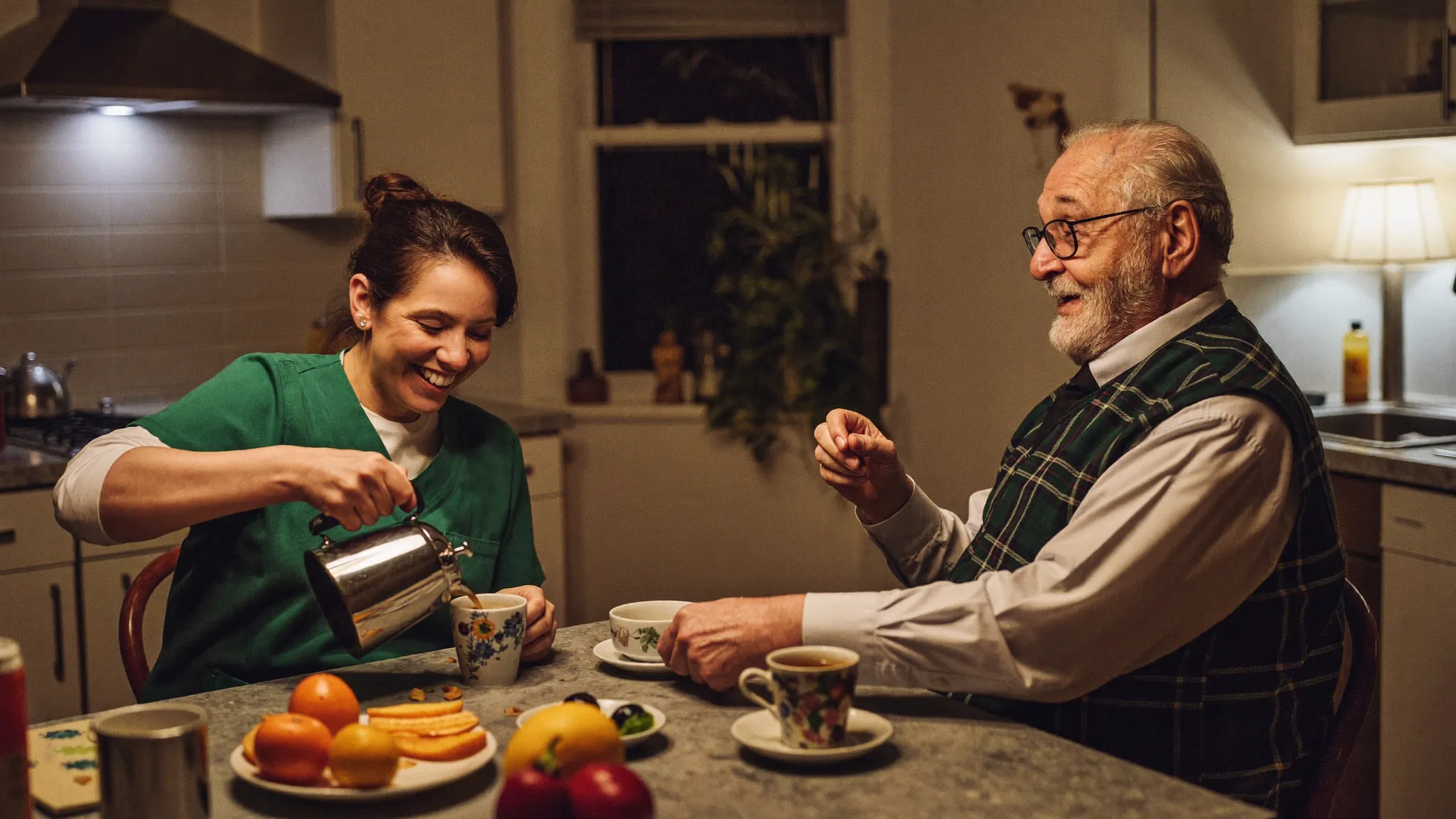
24-hour care at home means having trained support available day and night without moving anywhere. With us in Surrey it starts at £245 per full 24 hours for live-in care, roughly £1,715 a week (July 2026 rates), with your exact price confirmed after a free home assessment. Other models mix daytime visits with overnight care.
The confusing part is that “24-hour care” is not one product. It is three quite different arrangements wearing the same name badge, at three quite different prices. Here is each one in plain English, with honest numbers, and the comparison with a care home that most brochures mysteriously forget to include.
What are the three models of 24-hour care at home?
Every 24-hour arrangement we set up is one of these, or a blend:
- Live-in care. One professional carer lives in the home, providing support through the day and being on hand overnight. One familiar face, one routine, and the model most families mean when they say “round the clock care”. This is our live-in care service, and it works for couples too: one carer, one bill.
- Day visits plus waking nights. Daytime visiting care combined with a carer who stays awake all night. This suits complex needs: frequent turning, medication through the night, or someone who is up and about at 3am and needs skilled company rather than a person snoring heroically in the spare room.
- Day visits plus sleeping nights. Daytime visits combined with a carer who sleeps at the house and gets up if needed. The right fit when nights are mostly settled but you want someone there, for reassurance, falls, and the occasional 2am cocoa summit.
Which model is right is not a matter of taste, it is a matter of what the nights actually look like. A person who sleeps through but should not be alone needs a very different arrangement, at a very different price, from a person who needs skilled support at 2am, 4am and 5.30am. This is precisely what our free home assessment works out, and it is why we do the assessment before quoting rather than guessing from a phone call.
What is the difference between a waking night and a sleeping night?
These two get muddled constantly, and the price difference makes the muddle expensive, so here it is plainly.
A waking night carer is awake, dressed and on duty all night, from £30 an hour with us. You are paying for active care through the small hours: repositioning, medication, personal care, and calm, skilled company for someone who is awake too.
A sleeping night carer sleeps at the house, at £175 a night (10pm to 7am), and gets up when needed. You are paying for presence: someone there if there is a fall, a worry, or a kettle that urgently needs operating at 3am. If the carer is being woken repeatedly, night after night, that is your cue that the need has quietly become a waking night, and it is better to have that conversation early than to burn out a good arrangement.
Plenty of families also use night cover on its own, without the full 24-hour package, often as respite so the family member who has been doing the nights can remember what sleep is. We are told it is wonderful.
How much does each model cost?
Our July 2026 from-rates, same Monday to Sunday, no weekend premium; Bank Holidays are double the standard rate. The night-model weekly figures are worked examples we have calculated from those from-rates, labelled as such, because nobody enjoys discovering arithmetic surprises later:
| Model | From-rate | Worked weekly example | Best suited to |
|---|---|---|---|
| Live-in care | £245 per full 24 hours | £1,715 a week, everything included | Ongoing round-the-clock support with one familiar carer |
| Day visits + waking nights | Waking night from £30 an hour | A 9-hour night (10pm to 7am) from £270, so from about £1,890 a week for nights alone, before daytime visits | Shorter-term or complex needs with active care through the night |
| Day visits + sleeping nights | Sleeping night (10pm to 7am) at £175 a night | From £1,225 a week for nights, plus daytime visits from £29.95 each | Settled nights where presence and reassurance are the point |
Two things jump out of that table. First, waking nights cost more than live-in care, which is why the waking-night model tends to be a short-term or clinical choice rather than a forever plan. Second, live-in care is usually the value option for genuine 24-hour needs, because one rate covers the whole day and night. Full details on our pricing page, and more on nights specifically on our night care page.
What does 24-hour care at home actually include?
Whichever model fits, the day-to-day content is the same broad job: personal care such as washing, dressing and continence support, medication support, cooking proper meals, keeping the house running, and companionship, which is officially a line on the care plan and unofficially the reason half our customers answer the door smiling.
A few practical points worth knowing before you compare providers:
- For live-in care, the carer needs a bedroom. A spare room, however modest, is the one non-negotiable piece of kit. If the box room is currently an archive of carrier bags, you are in excellent company.
- Ask who employs the carers. Our 52 carers are trained, DBS-checked and employed directly by Aims, not gig workers matched by an app. That is who arranges training, insurance, and cover when someone is ill or on holiday, so it is not a small detail.
- Check the regulator and the reviews. We are CQC regulated (you can check any provider at cqc.org.uk) and rated 9.5 out of 10 from 58 reviews on homecare.co.uk. Fifteen-plus years and 2,000-plus families in, we would frankly be embarrassed by anything less.
- Rates that do not spike. Our from-rates are the same Monday to Sunday, with no weekend premium; Bank Holidays are charged at double the standard rate, because needing care on a Sunday is not a luxury choice.
How does 24-hour home care compare with a care home?
Here are the July 2026 numbers side by side:
The honest reading: live-in care £1,715 a week sits a little above the £1,298 average residential home and almost level with the £1,535 average nursing home (carehome.co.uk, updated 30 July 2026). Over a year those care home averages come to roughly £67,496 for residential and £79,820 for nursing care, and fees rose by around 10% in the year to December 2025, so the gap is not standing still. What the averages cannot show is the one-to-one part: in a care home, staff are shared across many residents; at home, the carer’s whole working attention belongs to one person, in the house where they know which floorboard creaks. Perhaps that is why 97% of people say they would prefer to stay in their own home rather than move into a care facility.
For a couple, the comparison tilts hard towards home, because a care home charges per person while live-in care is one carer and one bill. And the means test treats home differently too: for care in your own home your house is never counted as an asset, while for a permanent care home move it usually is, unless a partner still lives there. We have unpacked all of that in our live-in care versus care home comparison.
One caution while you research. Some care providers’ pages still describe the £86,000 lifetime cap on care costs as a change that is on its way. It is not. The cap was cancelled on 29 July 2024 and nothing has replaced it (House of Commons Library briefing CBP-9315). If a page you are reading has not caught up with a two-year-old cancellation, treat its prices with similar suspicion.
Who pays for 24-hour care at home?
- The council, if a means test says so: above £23,250 in assets you self-fund, between £14,250 and £23,250 the council contributes on a sliding scale, and below £14,250 savings are ignored though most income still goes to fees (2026/27 figures). The needs assessment that starts it all is free from Surrey County Council (0300 200 1005), whatever your wealth.
- The NHS, through NHS Continuing Healthcare, which can fund a full package at home, including live-in care, with no means test, where needs are primarily health-related. Under-claimed and worth screening for; our funding support team helps families through it.
- Attendance Allowance, £76.70 or £114.60 a week (2026/27), not means-tested, for people over State Pension age who need help with daily living. It will not fund the whole package, but it is real money towards it. Details at gov.uk.
What should you do next?
- Write down what the nights are actually like. Settled, restless, or genuinely active? That one honest answer usually picks the model for you.
- Get the free needs assessment from the council, and ask about a Continuing Healthcare checklist at the same time. Both are free, neither obliges you to anything.
- Book a free home assessment with us. We will tell you plainly which model fits, what it will cost, and, if we think you need less care than you feared, we will say so. Care can start within 24 to 48 hours of the assessment.
Frequently asked questions.
Is live-in care the same as 24-hour care?
Live-in care is one model of 24-hour care: a carer lives in the home, supporting through the day and on hand at night. The alternatives combine daytime visits with waking or sleeping night cover. Which fits best depends mainly on what happens overnight.
Does a live-in carer really work 24 hours without a break?
No, and be wary of anyone who claims otherwise. Carers are human: they need breaks and proper sleep, so the arrangement is planned around the person’s actual pattern of needs, with cover arranged for time off. That planning is exactly what the free assessment sorts out.
Is 24-hour home care cheaper than a care home?
Sometimes, and for couples usually. Live-in care £1,715 a week compares with July 2026 averages of £1,298 for residential and £1,535 for nursing homes, per person. At home your house is also never counted in the means test, which changes the sums for many families.
How quickly can 24-hour care at home start?
Care can begin within 24 to 48 hours of your free home assessment, including live-in care. For urgent situations, a hospital discharge or a family carer suddenly unavailable, tell us when you call and we will move at the speed the situation needs.
If the nights have become the hard part, or you are comparing quotes and going quietly cross-eyed, call our Leatherhead team on 01372 386222 or book a free assessment. We will bring the honest numbers. You provide the kettle.
Sources and references.
- Aims Homecare price sheet, July 2026, at aimshomecare.co.uk/pricing (all from-rates and worked examples)
- carehome.co.uk, care home fees and costs, updated 30 July 2026 (average weekly fees)
- House of Commons Library, briefing CBP-9315: the cap on care costs (cancellation of 29 July 2024)
- GOV.UK, Social care charging for 2026/27, local authority circular, 17 February 2026 (means-test thresholds)
- GOV.UK, Attendance Allowance, 2026/27 rates
- NHS, NHS Continuing Healthcare
- Surrey County Council, adult social care, 0300 200 1005
Where to go next.
- Live-in care at £245 per 24 hours
- Sleeping and waking night care
- Live-in care for couples
- The full live-in cost breakdown
Or talk it through with a person: call 01372 386222 or book a free assessment.