To hire a private nurse for home care, you have three routes: a nursing agency, a CQC-registered home care provider whose service includes nurse-led care, or employing a nurse directly (checking their registration on the Nursing and Midwifery Council register). But here is the twist: many families searching for a “private nurse” discover they actually need something different, and considerably less expensive.
So before you ring a nursing agency and brace yourself for the quote, give us five minutes. This guide covers who does what, how hiring actually works, what it costs, and the NHS funding route that many families are never told about.
Do you actually need a nurse, or a care professional?
This is the question that saves families the most money, so we are putting it first.
“Nurse” has become shorthand for “trained person who helps at home”, in the same way every vacuum cleaner is a Hoover. In reality, registered nurses and care professionals do different jobs, and most day-to-day support at home is care work, not nursing.
| Usually a registered nurse | Usually a trained care professional |
|---|---|
| Injections and IV medication | Medication prompts and collection |
| Wound dressing and pressure sore management | Washing, bathing and dressing |
| Catheter and stoma changes, PEG feeding | Catheter and stoma day-to-day support |
| Clinical assessments and syringe drivers | Meals, mobility, companionship, routine |
Notice how much of ordinary daily support sits on the right-hand side. If your mum needs help washing, dressing, eating well and staying safe, that is personal care, delivered by trained, DBS-checked care professionals. If she also needs a weekly wound dressing, that single task is often covered by an NHS district nurse who visits at home, free, arranged through the GP surgery. Sandwiching an NHS nurse visit between daily care visits is how thousands of UK households actually run, and it works.
How do you hire a private nurse?
- Start with the GP. Describe what is happening. If there is a genuine clinical need, the GP can refer to district nursing, which is free at home. Never pay privately for something the NHS already provides.
- Check the register. Anyone calling themselves a nurse should appear on the NMC register. Searching it is free and takes a minute. A genuine nurse will not be offended; the good ones are proud of their PIN.
- Choose regulated over casual. An agency or provider registered with the Care Quality Commission is inspected, insured and accountable. Hiring an individual directly can work, but you become the employer, with payroll, insurance, cover for sickness and holidays, and no inspector checking standards. It is more admin than most families expect, roughly the difference between owning a dog and running a kennel.
- Interview for the boring things. Insurance, references, what happens when your nurse is ill, and who supervises quality. Charm is lovely; cover arrangements matter more at 6am on a Sunday.
What does a private nurse cost?
Private nursing agencies set their own rates, which vary widely by region and task, so get at least two quotes in writing rather than trusting any national average you read online, including from us. What we can tell you with confidence is the relationship: nurse-led care costs a multiple of care work, because you are paying for clinical registration, indemnity and skills you may only need for minutes at a time.
That is why the smart structure for most families is layered: care professionals for daily living, district nurses or a private nurse for the genuinely clinical moments. As a comparison point, our care visits start from £22 for 30 minutes and £28 for an hour, with overnight care from £150 a night and live-in care from £225 per 24 hours (July 2026 from-rates; exact quote after a free home assessment).
Can the NHS pay for nursing care at home?
Sometimes, yes, in full, and this is the part too few families hear about.
NHS Continuing Healthcare is a package of care fully funded by the NHS for people whose needs are primarily health-related. It is not means-tested. Your house and savings are irrelevant. And crucially, it can be delivered in your own home, not just in a nursing home. Eligibility rests on assessed needs rather than diagnosis, and there is a fast-track route for people who are terminally ill, usually decided within 48 hours. The NHS explains the process here, and we help Surrey families prepare the evidence as part of our free funding support.
One wrinkle worth knowing: NHS-funded Nursing Care, a separate weekly payment (£267.68 standard rate from April 2026), applies only in care homes with nursing. It does not apply to care in your own home, whatever a confident person on a forum may claim.
What about overnight nursing?
Nights are where the nurse-versus-carer question gets expensive, so it deserves its own paragraph. Families often assume a bad run of nights means hiring a night nurse, and a private overnight nurse is one of the priciest arrangements in home care. In practice, most overnight needs are not clinical at all: reassurance after a fall, help to the bathroom, repositioning for comfort, medication at set times, or simply someone awake so the family carer can finally sleep like a person rather than a meerkat.
All of that is care work, not nursing. A waking night carer (awake all night, from £29 an hour) or a sleeping night carer (on hand nearby, from £150 a night) covers it, at a fraction of nurse rates. Where a genuinely clinical overnight need exists, for example a syringe driver in palliative care, the answer is usually the NHS: district nursing teams and hospice-at-home services work overnight, arranged through the GP or palliative team, and NHS Continuing Healthcare’s fast-track route exists precisely for these situations. The workable pattern for many families is NHS clinicians for the clinical minutes, and a steady, awake carer for the other eight hours.
Where does Aims Homecare fit in?
We are a home care provider, not a nursing agency, and we would rather tell you that plainly than blur it the way some websites do. Here is what our team actually brings to a household with health needs:
- Trained, DBS-checked care professionals supporting medication, personal care, meals and mobility, in the green Aims uniform, so you always know who is at your door.
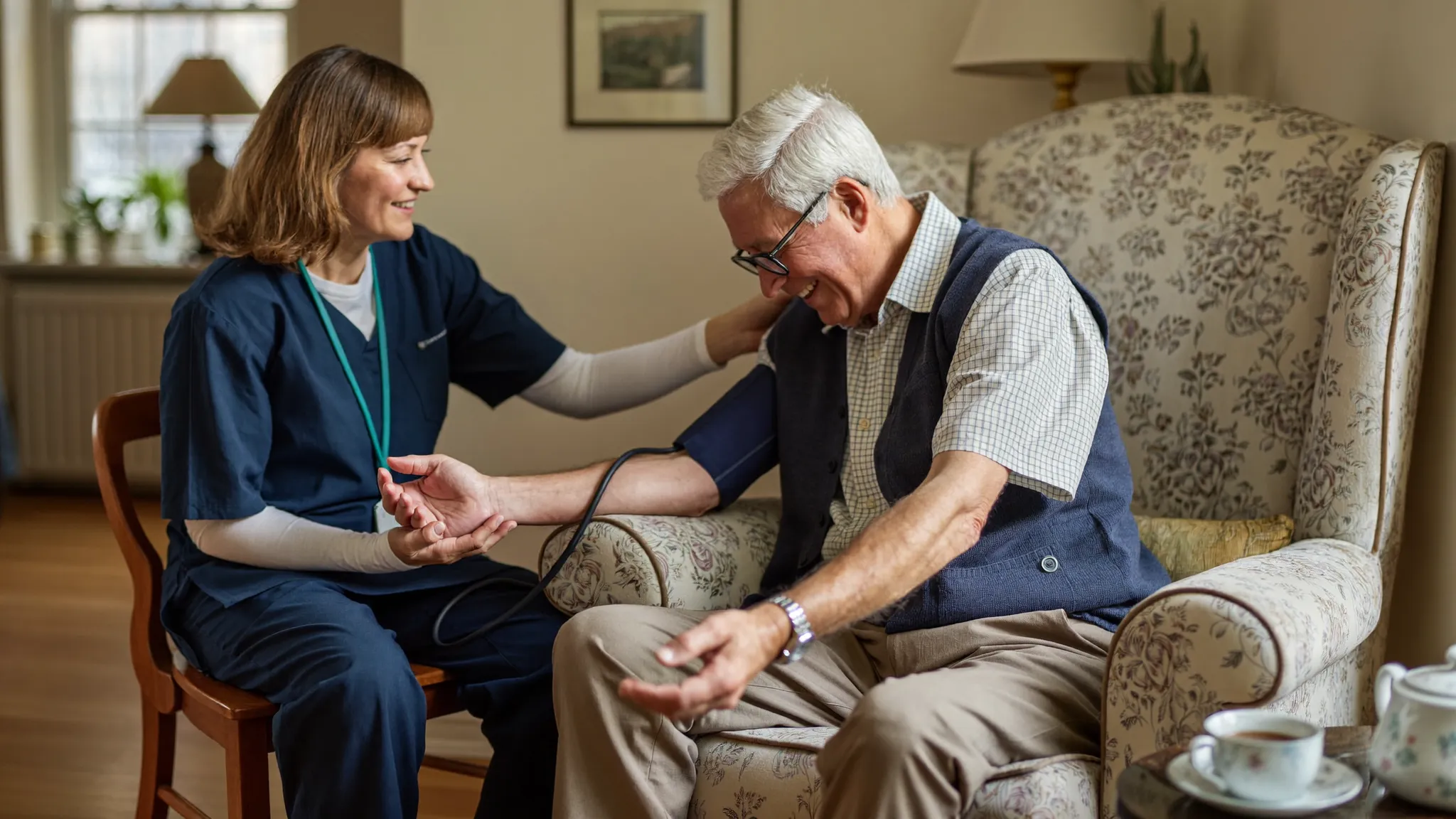
- Health and wellbeing checks using an NHS-style early-warning scoring system: blood pressure, pulse, temperature, oxygen levels and alertness, with concerns escalated to healthcare professionals promptly.
- Carers who work alongside district nurses, GPs and hospice teams every week, including in palliative care, where the NHS handles the clinical side and we handle comfort, dignity and daily life.
Fifteen years of doing this has taught us where the line between nursing and care sits in real kitchens, not just on paper. If what you describe at assessment needs a nurse, we will say “that bit needs a nurse” and point you in the right direction.
Frequently asked questions.
How do I check someone really is a registered nurse?
Search the Nursing and Midwifery Council register online, free, using their name or PIN. Every legitimate UK nurse appears there. If an agency hesitates to share a nurse’s PIN, treat that as your answer and look elsewhere.
Can I get a nurse at home for free through the NHS?
Often, yes. District nurses visit at home free of charge for tasks like dressings, injections and catheter care, arranged via the GP. For ongoing complex health needs, ask about NHS Continuing Healthcare, which is not means-tested.
Do Aims carers handle medication?
Our trained care professionals prompt, remind and collect prescriptions, and support people to take medication as prescribed. Clinical tasks such as injections sit with nurses, and we coordinate with district nursing teams so nothing falls between the two.
What if needs change and care work is no longer enough?
Care plans are reviewed regularly, and we adjust visits, add nights or step up to live-in support as things evolve. If a clinical need emerges, we flag it early to the GP or district nurse rather than quietly working beyond our remit.
If you are unsure which kind of support your family actually needs, that is exactly what our free assessment is for. Call the Leatherhead office on 01372 386222 or book a visit, and we will map it out with you honestly.
Sources and references.
- Nursing and Midwifery Council, search the register
- NHS, NHS Continuing Healthcare (including the fast-track route)
- GOV.UK, NHS-funded Nursing Care rates from April 2026
- Care Quality Commission, check a care provider’s registration
- Aims Homecare price sheet, July 2026, at aimshomecare.co.uk/pricing
- MoneyHelper, Long-term care guidance